.png)
Beyond the Tariffs: The Parts of the UK India Trade Deal North East Businesses Are Overlooking

The Quick Answer
The UK India Free Trade Agreement, in force since 15 July 2026, covers far more than tariff cuts. The agreement runs to 30 chapters and includes provisions on professional services, business mobility, digital trade, government procurement, and dedicated SME support. For North East businesses selling expertise rather than products, these overlooked chapters may prove more valuable than any tariff line.
Almost every headline about the UK India Free Trade Agreement has focused on one thing. Tariffs. Whisky down from 150% towards 40%. Cars from 100% to 10%. And rightly so. For the region's distillers and manufacturers, those cuts are transformational.
But if tariffs are the only part of the deal you have read about, you are seeing a fraction of the opportunity.
The UK and India traded around £48 billion in 2025. The Government expects the agreement to add £25.5 billion to bilateral trade each year in the long term and £4.8 billion to UK GDP annually. A tariff reduction only matters, though, if your business sells something subject to tariffs.
A professional services consultancy does not ship a container through customs. A software company does not need a warehouse in Mumbai. A university does not export its expertise the way a manufacturer exports vehicles.
For businesses across Newcastle, Gateshead, Sunderland, Durham and the wider North East, the most valuable opportunities could sit in the chapters nobody is talking about.
What Does the UK India Trade Deal Cover Beyond Tariffs?
Five provisions rarely make the headlines. Each one opens a door for North East businesses.
1. How does the deal help services businesses and professional mobility?
This is arguably the most significant part of the deal for a modern, services led economy like the North East's.
The agreement includes a dedicated services chapter, giving UK service suppliers greater certainty and transparency in the Indian market. It also eases mobility for professionals across IT, healthcare, finance and education, with streamlined entry routes for business visitors, intra corporate transferees, contractual service suppliers and independent professionals.
In practice, that means a consultancy in Newcastle could support an Indian client without establishing a physical operation. A technology company in Sunderland could provide digital services into India. An engineering consultancy in Durham could explore infrastructure and energy partnerships. An education provider could build commercial relationships with Indian institutions.
The opportunity is not about selling more products. It is about selling what the North East already has in abundance. Knowledge. Expertise. Technology. Research. Professional capability.
Immigration rules still apply, and visa eligibility requirements remain in place. But the framework for temporary business travel is now clearer than it has ever been.
2. What is the Double Contribution Convention and why does it matter?
Alongside the trade deal sits a quieter agreement with a real financial impact.
The Double Contribution Convention means employees temporarily working in the other country no longer pay social security contributions in both the UK and India at the same time.
If you have ever considered posting staff to India, this removes a significant and often overlooked cost. For firms building a presence in the market, it materially changes the maths of sending your people there.
3. Can UK businesses bid for Indian government contracts?
Yes, and for the first time.
The agreement gives eligible UK businesses access to covered areas of India's central government procurement market, reportedly around 40,000 tenders a year worth tens of billions of pounds. This market was effectively closed to British firms before the deal.
Opportunities span infrastructure, transport, healthcare, energy, technology, education and consultancy. For North East companies in construction, engineering, professional services and advanced manufacturing, that is an entirely new pipeline that most competitors have not even registered yet.
Government contracts also open India to businesses that assumed international expansion required a large consumer product operation. It does not. A specialist consultancy may have something valuable to offer. So might an engineering business. So might a technology company.
4. What does the digital trade chapter mean for North East tech businesses?
One of the most overlooked parts of the deal is digital trade.
CETA contains a dedicated digital trade chapter covering electronic contracts, electronic authentication, digital trading systems and cross border data flows, alongside protections for source code and digital consumers.
For the region's software developers, SaaS companies, digital agencies, cyber security firms, data specialists, EdTech companies and AI businesses, this is potentially far more relevant than any automotive tariff.
It changes the question North East businesses should be asking. Not simply what can we export to India, but what can we deliver to India digitally.
5. Has the deal been designed for SMEs?
Yes. The agreement contains a dedicated SME chapter with simpler processes, improved access to information, and named contact points designed to help smaller firms actually use the deal.
This is not an agreement written only for multinationals. It is structured so the North East's owner managed businesses can take advantage of it too.
The region has thousands of SMEs with specialist expertise. The challenge is rarely whether the capability exists. It is whether the business knows where the opportunity is, who to speak to, and how to enter the market properly.
Key Takeaways
The UK India trade deal beyond tariffs, at a glance: A dedicated services chapter giving UK suppliers certainty in the Indian market Streamlined mobility routes for professionals across IT, healthcare, finance and education The Double Contribution Convention ending dual social security payments First time access to around 40,000 Indian government tenders a year A digital trade chapter simplifying cross border digital delivery A dedicated SME chapter built for owner managed businesses
What Should North East Businesses Do Now?
The biggest opportunity may not be to start exporting physical products to India. It could be to look at your business differently. Ask yourself five questions.
What expertise could we sell in India? Think beyond products. Consider consultancy, training, software, research, design, engineering, education and specialist professional services.
Could we deliver some of this digitally? Digital trade removes some of the physical barriers associated with international expansion.
Would our people need to travel? If your service requires meetings, project delivery or relationship building, understand the mobility provisions and the immigration requirements that still apply.
Could we sell into Indian public sector projects? Look at procurement opportunities across technology, healthcare, education, infrastructure, energy and consultancy.
Who could help us enter the market? This may be the most important question of all. A trade agreement does not automatically create a market. It creates a framework. Businesses still need market intelligence, local relationships, cultural understanding, commercial planning and a clear route to market.
How ISS Airview Turns this Opportunity Into Action
Understanding the opportunity is one thing. Acting on it, finding partners, navigating procurement, moving people, building relationships on the ground, is another. And it is far harder to do from a desk in the North East.
That is exactly where ISS Airview comes in.
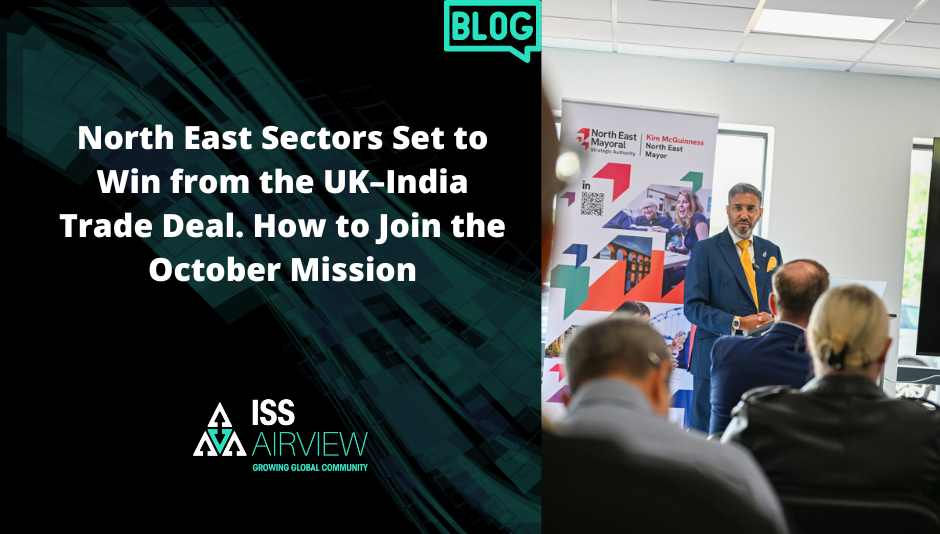
Based at Newcastle International Airport, ISS Airview is the North East's gateway to international trade, investment and innovation. Through the North East Mayor's Trade Mission to India this October, we are taking a delegation of North East businesses directly into the market, with visits to Delhi, Mumbai, Bengaluru and Chennai. It is the moment to turn these provisions into real relationships and real contracts.
When the North East turns up together, people take notice.
For businesses considering India, the first step should not necessarily be a flight. It should be a conversation. Where does your proposition fit? Who is already operating in the market? What does market entry actually look like for your business?

Frequently Asked Questions
What does the UK India trade deal mean for North East businesses?The agreement creates opportunities across goods, services, digital trade, government procurement and business mobility. For North East businesses, this means routes into India through services and expertise as well as traditional exports.
Does the UK India trade deal only benefit exporters of physical goods?No. The agreement covers services, digital trade, government procurement and temporary movement of business people. Professional services, technology, consultancy and education businesses can all explore opportunities in India.
Can North East technology businesses sell digital services to India?Yes. CETA includes a dedicated digital trade chapter covering electronic contracts, electronic authentication and cross border data flows. Businesses must still comply with relevant UK and Indian laws.
Does the UK India trade deal make business travel easier?The agreement contains provisions covering temporary movement of business people and provides greater transparency around business travel. Immigration requirements and eligibility conditions still apply.
Can UK businesses bid for Indian government contracts?Yes. Eligible UK businesses now have access to covered areas of India's central government procurement market, spanning infrastructure, transport, healthcare, energy, IT, education and consultancy.
How can a North East business enter the Indian market?Start with market research and sector analysis. Identify potential customers and partners, understand regulatory requirements and establish a clear route to market. Working with an experienced market entry partner such as ISS Airview reduces uncertainty and builds the right connections.
Want to explore what the UK India deal really means for your business, beyond the tariffs? Get in touch with ISS Airview at Grow.global@issairview.com .


Comments